
Dallas Projected Versus Actual Release
A projected date is a calculation based on current sentence, credit, eligibility, and agency data. It predicts a possible statutory endpoint. The actual release date records when the custodian's control ended or changed. The two can differ because a court order, detainer, program, disciplinary action, sentence correction, or Board decision changes the path.
A Dallas pretrial detainee has no sentence-completion date. Release may depend on bond, dismissal, a hearing, other cases, holds, and jail processing. A person serving a local sentence may have a calculable endpoint, but county calculations should not be inferred from TDCJ rules. A state prisoner follows Texas corrections statutes and TDCJ records.
| Custody | Date source | Main limit |
|---|---|---|
| Dallas pretrial | Court, bond, holds, jail status | No fixed sentence date |
| Dallas local sentence | Judgment and jail records | Local calculation and other holds |
| TDCJ prison | Projected Release Date field and state contacts | Projection can change |
| Federal or ICE | BOP or ICE channels | Different agency rules |
Find Dallas Projected Release Dates
First determine whether the person is in Dallas County custody or TDCJ. The TDCJ offender search accepts last and first name, TDCJ number, SID number, gender, and race. It requires at least a last name plus first initial, a TDCJ number, or a SID. Last-name matching is exact. The system includes only people currently incarcerated and can be at least 24 hours behind.
- Identify the current custodian from the booking, judgment, or state number.
- For TDCJ, search the TDCJ or SID number when available.
- Save the current unit, offense data, and Projected Release Date.
- For Dallas County, read the signed judgment and ask jail records for the local calculation.
- After the projected day, confirm actual release through the responsible agency.
TDCJ's email information route can provide the exact Projected Release Date field. Send the full name and seven-digit TDCJ number to pia@tdcj.texas.gov, following the official alternative when the number is unknown. The response may include location, conviction and incarceration information, history, and the projection. It does not provide photographs.
The Dallas County release search explains how to confirm the later actual event.
Texas Good-Time Release Calculations
Texas Government Code Chapter 498 governs good-conduct time. Section 498.003 authorizes credits based on classification. Good time applies to parole or mandatory-supervision eligibility and does not otherwise shorten the judicial sentence. Section 498.004 permits forfeiture, so discipline and classification changes can move a projection.
Texas has no blanket 85 percent rule. For the serious or deadly-weapon cohort listed in Government Code section 508.145(d), first parole eligibility generally uses actual calendar time, without good-conduct credit, equal to one-half the sentence or 30 calendar years, whichever is less, subject to the statutory minimum. That is eligibility for discretionary review, not a promised release date.
Mandatory supervision is separate. Section 508.147 links eligibility generally to calendar time plus accrued good-conduct time equaling the sentence, subject to section 508.149 exclusions and review. An ineligible or denied prisoner may remain until discharge. Use the live statute and individual TDCJ calculation rather than a slogan or percentage.
Why Dallas Release Dates Change
A projection changes when the facts or rules used in the calculation change. TDCJ may recalculate after discipline, classification, a new sentence, or corrected records. BPP may approve, deny, delay, or condition a parole path. A detainer can redirect custody even when one sentence reaches its endpoint. County release can likewise wait on another case or hold.
| Factor | Effect |
|---|---|
| Good-time loss | Can move eligibility or the displayed state projection |
| Parole vote | May set a future date or required program, not immediate release |
| Detainer or hold | Can redirect the person to another custodian |
| New or consecutive sentence | Changes the controlling time calculation |
| Court correction | Can alter sentence data used by the agency |
| Program completion | May control an approved release path |
Before a favorable parole vote, call BPP status at 844-512-0461. After a vote for release, call TDCJ Parole Division at 512-406-5202 with the TDCJ or SID number or date of birth. Ask for actual status, not only the Board decision.
Confirm Dallas Actual Release Dates
Texas VINE can provide an agency-reported custody event and a notification when offered. Register from the correct record and preserve the reporting agency. An “Out of Custody” result is specific to that agency and is not a certified release sheet. The Dallas County VINE inmate check explains registration and confirmation.
For Dallas County, request the Sheriff custody transaction showing actual date, time, disposition, and destination. For TDCJ, use telephone, parole, email, or records channels. Because the online TDCJ search is current-only, a released person does not remain as a historical released result. Absence after a projection is consistent with release but does not prove it.
A court judgment explains the sentence or legal outcome. It does not alone prove the physical departure time, especially when another warrant, detainer, or processing step remains.
TDCJ Projected Release Field
TDCJ uses the exact label “Projected Release Date.” For eligible pre-September 1, 1996 offenses, TDCJ explains that the projection can reflect mandatory release if parole does not occur. For eligible later offenses, mandatory supervision is discretionary with BPP, and a denied or ineligible person may have discharge as the projection. The field's meaning therefore depends on offense date and eligibility.
The matched TDCJ email-information source shows the official field and request channel.
Review the TDCJ email information instructions before sending identifiers.
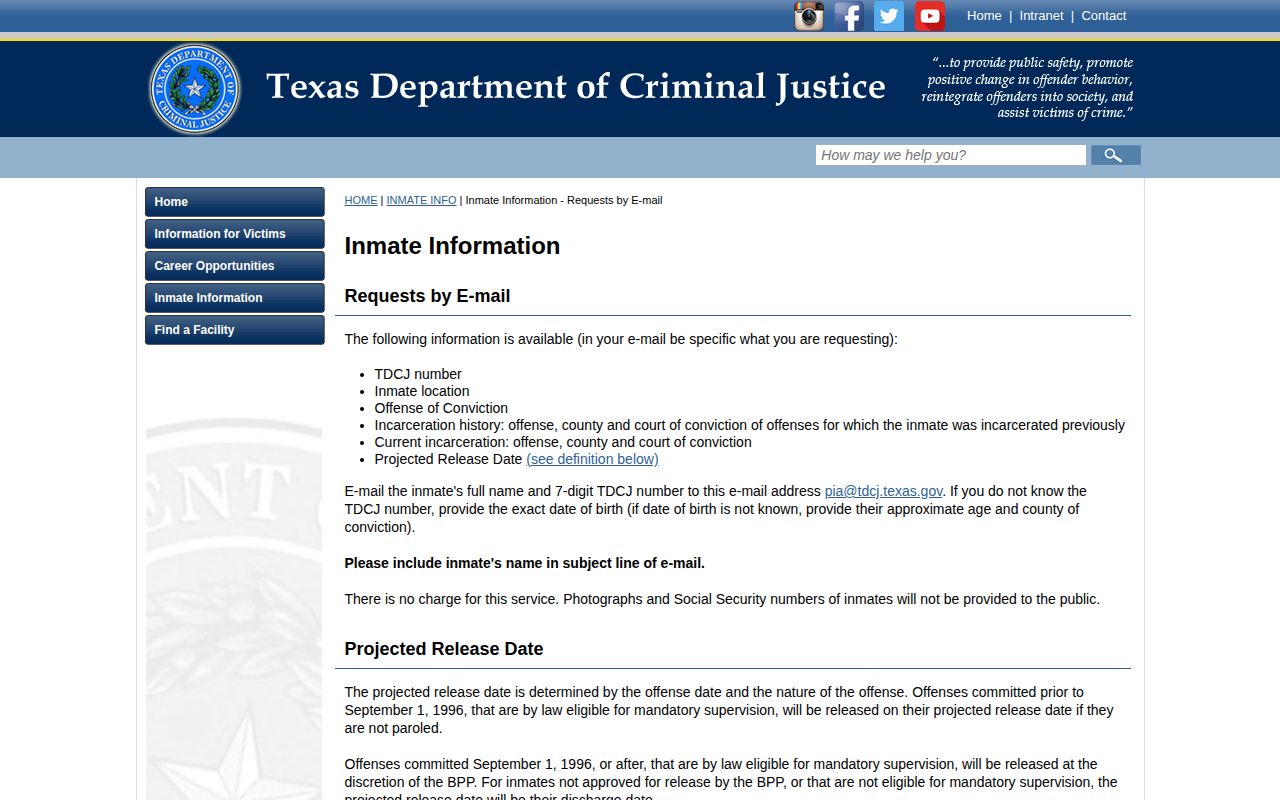
The image confirms the field name and channel. It does not certify that the projected event later occurred.
Dallas Release or Transfer Date?
Research Section 19 angle T is locally distinctive. Dallas County's January 2026 operational packet separates transfers to TDCJ Institutional Division, Intermediate Sanction Facility, Substance Abuse Felony Punishment Facility, and State Jail from time-served processing. That vocabulary shows why an operational “release” can mean movement into another custodial placement.
When a Dallas roster entry disappears near a court date, inspect the judgment and request the Sheriff transaction. A TDCJ commitment points to state intake, not community release. The receiving system may take time to show the person. Keep the county endpoint and state intake as separate timestamps.
Dallas Parole Date Limits
Texas BPP does not conduct formal individual parole consideration hearings or publish an inmate hearing calendar. Panel members review files and vote individually. Board business meetings are not release hearings. A vote code may describe a future date, required program, denial, or later review, but it remains a decision rather than the gate time.
The matched parole-information source below supports the post-vote confirmation route.
Use the TDCJ parole information contacts after reviewing the current status.
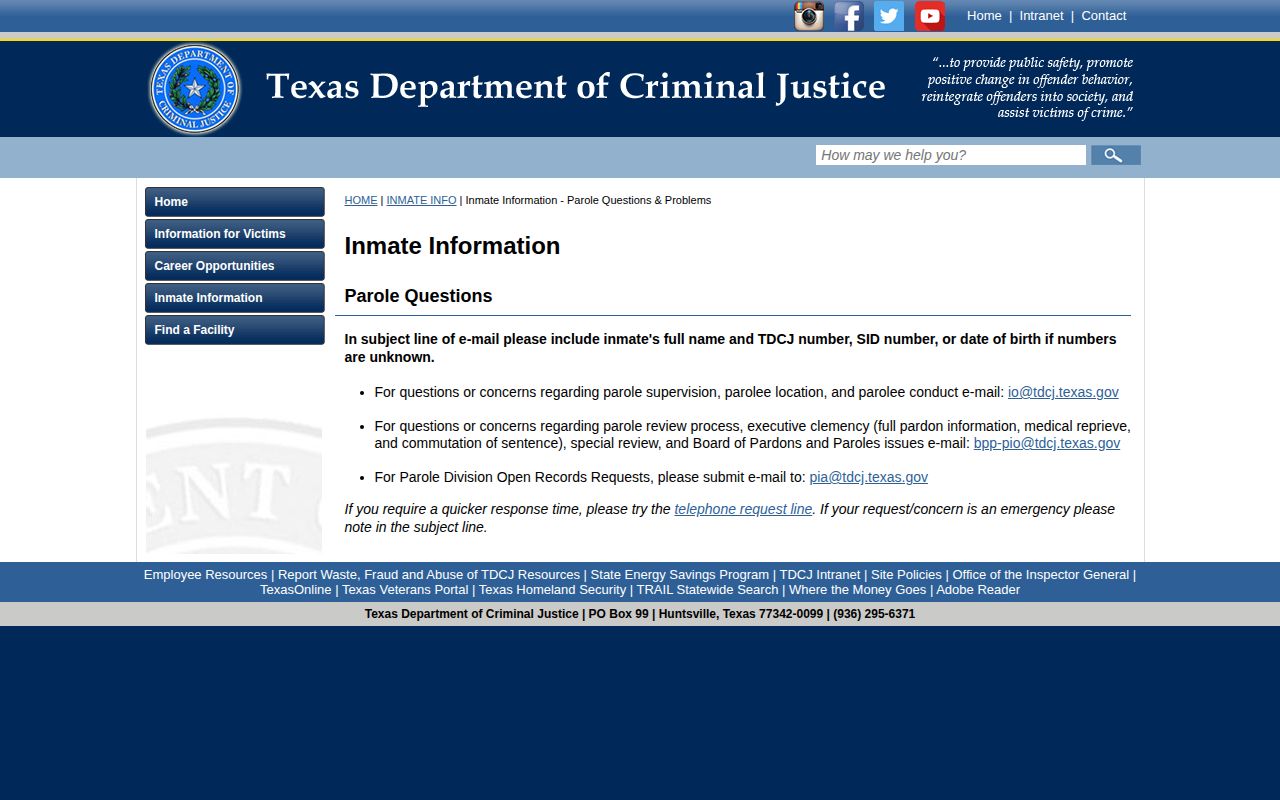
The source connects a projected parole path to TDCJ status contacts. It is not an individual hearing calendar.
Public Record Search
Sponsored Results