
Dallas Parole Versus Probation
Parole is discretionary release from TDCJ imprisonment so the person serves the remaining sentence under state supervision. The Texas Board of Pardons and Paroles makes parole decisions, while the TDCJ Parole Division administers supervision. Probation is ordered by a court in place of, or as part of, a local sentence. Dallas County Community Supervision and Corrections Department administers that court-ordered supervision. The two agencies do not share one public lookup.
Mandatory supervision is also distinct. It is a statutory state release method tied to calendar time, good-conduct time, legal eligibility, and Board review. It is not Dallas County probation. A person can leave county jail with a probation order, leave TDCJ on parole or mandatory supervision, or finish a sentence by discharge with no further supervision.
| Type | Decision source | Dallas verification route |
|---|---|---|
| Parole | Texas BPP | TDCJ Parole Division and assigned Region II office |
| Mandatory supervision | Texas statute and BPP review | TDCJ/BPP status and release record |
| Probation | Dallas criminal court | Signed judgment and Dallas County CSCD |
| Discharge | Controlling agency or court | Final discharge record |
- Parole
- State supervision after discretionary release from prison.
- Probation
- Court-ordered community supervision administered locally.
- Absconder
- A person alleged to have stopped reporting or complying, not someone proven discharged.
- Discharge
- The formal end of custody or supervision recorded by the responsible agency.
Verify Dallas Post-Release Supervision
Begin with the sentence source. A TDCJ number, state prison location, or Board vote points to the state parole path. A Dallas felony or misdemeanor judgment ordering community supervision points to CSCD. The current TDCJ offender search includes only people still incarcerated, so absence after release is not a retained parole result. There is no general public Texas database of every released parolee.
- Read the court judgment or last confirmed custody record.
- For TDCJ parole, call Parole Division status at 512-406-5202 after a release vote.
- Use the live Region II directory to confirm the assigned Dallas parole office.
- For probation, verify the signed Dallas court order and contact CSCD through appropriate channels.
- Request the final discharge record when the question is whether supervision ended.
Before a Board release vote, BPP status is available at 844-512-0461. Provide the full name, TDCJ or SID number, or date of birth as directed. A vote can require a future date or program and can be withdrawn. It is not proof of physical release or current office assignment.
Dallas Supervision Office Records
Dallas County is served by multiple TDCJ Region II parole offices rather than one universal counter. The directory lists Dallas I through Dallas V, a Dallas IV satellite, and the Dallas I District Reentry Center. A residence or ZIP code does not prove assignment. Confirm the office through TDCJ before calling or visiting.
The Dallas County CSCD administrative office is the local route for probation questions tied to a Dallas court order. No public probationer lookup was established in the research. Supervision files can contain confidential information, so the court judgment is the best public starting point and CSCD should be contacted only for an appropriate, specific inquiry.
1300 W. Mockingbird Lane, third floor
Dallas, TX
Phone: 214-653-5300
Court-ordered probation, not parole
The TDCJ Region II directory provides current parole-office locations and telephone numbers. The Dallas County CSCD page provides the county probation route. Keep the agencies separate.
Dallas Supervision Violation Records
Conditions are the rules imposed by the controlling parole authority or court. An alleged violation can lead to a warrant, revocation process, or other agency action. A parolee may face a TDCJ/BPP warrant and revocation path. A probationer may face a motion to revoke or adjudicate and a capias, which is a court order authorizing arrest. These events do not prove that the allegation was sustained.
An absconder is generally someone alleged to have stopped reporting or complying. Absence from a wanted list does not prove good standing or discharge. Check the specific court docket for probation, and use the TDCJ/BPP channels for parole. Texas VINE can report an agency custody event, but it does not certify supervision completion. The VINE inmate check should be read with the reporting agency preserved.
When a warrant is recalled, a revocation is denied, or supervision resumes, use the filed order or agency record. Do not infer the outcome from an old alert or a search that returns no result.
Dallas Supervision Discharge Records
Supervision ends through a formal discharge or other controlling order, not merely because a person stops appearing in a current-custody search. For parole, request TDCJ or Parole Division information showing the actual discharge or current supervision status. For probation, inspect the Dallas court docket and signed discharge order. A completed sentence, early termination, revocation, and transfer of supervision are different outcomes.
The Texas Public Information Act may provide access to releasable existing agency records, subject to exceptions. Court records use the Dallas clerks, portal, and judicial-record rules rather than an ordinary executive-agency request. Ask for the existing final order or discharge entry. The Dallas County release-record search explains how the original custody endpoint differs from the later supervision endpoint.
Dallas Parole Review Results
Texas BPP does not hold formal individual parole or mandatory-supervision consideration hearings. Panel members review and vote files individually. Except for qualifying registered victims or notification participants, there is no public upcoming individual-review notice and no inmate hearing calendar to publish. Board workshops and business meetings posted on the BPP site are governance meetings, not prisoner release hearings.
Before release, call BPP status with the name, TDCJ number, and date of birth as directed. Vote codes can include approval paths with future dates or programs and denial paths with later review. A favorable vote does not supply the gate-release time. After the vote, use Parole Division status and then the assigned office. Historical confirmation belongs with records and parole channels because the current TDCJ search will no longer display a released prisoner.
Which Dallas Parole Office?
Research Section 19 angle R is specific to Dallas. Region II lists Dallas I at 1010 Cadiz, Dallas II at 1135 S. Jupiter Road in Garland, Dallas III at 1010 Cadiz, Dallas IV at 4925 Catron Drive, a Dallas IV satellite at 3330 S. Lancaster Road, Dallas V at 4940 S. Westmoreland Road, and the Dallas I District Reentry Center at 1010 Cadiz. These locations show why one countywide address is insufficient.
Use the current directory to obtain the phone for the assigned office and confirm assignment through TDCJ. Do not choose from residence alone. A person may report to a specialized office, satellite, or reentry center. The office record applies to parole administration and should not be confused with Dallas County CSCD probation.
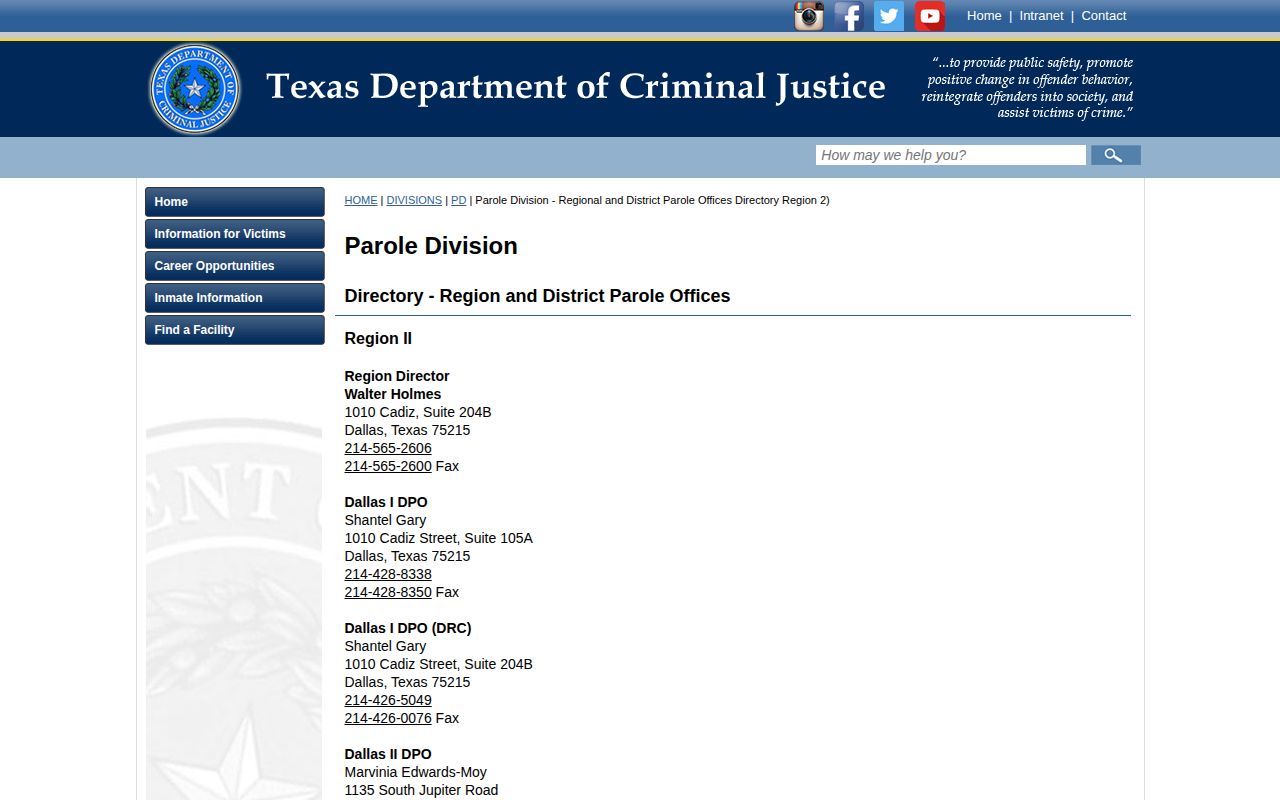
The official directory image demonstrates the multiple-office structure. It does not disclose an individual's assignment, which must be confirmed through TDCJ.
Dallas Release Property Trail
Research Section 19 angle H adds a practical local distinction. The Dallas Sheriff Vault holds personal property and cash until release. Vault Operations lists 214-653-2648, and property-release requests are handled from 10 a.m. to 8 p.m. daily under signature and identification rules. Clothing uses a separate process. This property trail can help explain an after-custody task, but it is not proof of parole, probation, or discharge.
A county property pickup belongs to the earlier jail event. TDCJ release property and identification processes belong to the state system. Keep the property record separate from supervision verification. The signed parole or probation record remains controlling.
Public Record Search
Sponsored Results