
Lew Sterrett Release Destinations
Lew Sterrett is the Dallas County Sheriff intake and release processing node for the county jail complex. That role makes it the key place in the paper trail, but it does not make every departure a release to the community. A person may leave after bond, time served, a dismissal that clears the case, or another court action. The Sheriff may also transfer the person to another county, a local custodian, the Texas Department of Criminal Justice, the United States Marshals Service or Bureau of Prisons, or U.S. Immigration and Customs Enforcement.
The strongest Dallas County record names the event, date and time, releasing location, and destination or receiving agency when recorded. A missing result in the Dallas County Jail Lookup means only that the current system did not return the person when checked. It does not identify which route occurred. The broader Dallas County released-inmate search and records path explains how the county, court, state, federal, and immigration sources fit together.
Confirm a Lew Sterrett Release
Start with a full name, date of birth or approximate age, booking number, arrest date, and case number. Repeated Dallas bookings and similar names can lead to a wrong match. Save the booking number, listed placement location, charges, bonds, and holds while a current record is still visible. Then compare sources that answer different questions.
- Check the Dallas County Jail Lookup. A live record supports current reported county custody, not a future release.
- Open the Dallas Courts Portal and review signed orders or judgments. A bond, dismissal, time-served judgment, probation order, or commitment can explain the legal path.
- Check Texas VINE for the Dallas reporting-agency event. “Out of Custody” applies to that agency and may include transfer.
- Call jail information for current clarification, then submit a Sheriff public-information request for the release transaction.
- Follow the destination. Use TDCJ for state prison, BOP or USMS for federal custody, ICE ODLS for immigration custody, or the named local jail.
A court order is not a gate timestamp. Bond may be posted while another warrant, detainer, or administrative step still blocks departure. VINE can supply a timely operational alert, yet the written Sheriff record is better proof of the precise county event.
Lew Sterrett Release Records
Dallas County does not publish a verified archive of people released in the last day or three days. Its current lookup shows booking and custody details, charges, bonds, holds, location, and a photo. It has no release fields or selectable recent-release window. Ask the Sheriff for the existing release screen, transaction, log, booking sheet, transfer destination, and booking photograph that match one booking. For a range of dates, describe the exact interval and request an existing daily release log or export rather than asking the county to create a new report.
| Source | What it can establish |
|---|---|
| Sheriff transaction | Actual Dallas County release or transfer event, time, type, and recorded destination |
| Live jail lookup | Current reported county custody, booking, placement, charges, bonds, and holds |
| Court record | The signed legal action that may permit or require release or transfer |
| VINE event | Status from the named reporting agency, subject to feed limits |
| Receiving agency | Custody after the Dallas County boundary ended |
Texas Government Code §552.021 governs access to public information subject to exceptions. Section 552.221 requires prompt handling, but ten business days is not a universal completion deadline. Confidential, sealed, juvenile, medical, victim-related, or otherwise protected details may be withheld. Online absence says nothing by itself about record retention.
Lew Sterrett Contact Details
The Sheriff lists Lew Sterrett at the county jail complex and provides one jail information number for current custody questions. Written requests are the more useful route when the exact release time, event type, or destination must be preserved. The bond desk and property operations are separate functions and should not be treated as release-record counters.
Lew Sterrett Intake/Release Center111 W. Commerce Street
Dallas, TX
Jail information: 214-761-9025
Release records: Dallas County Sheriff public-information request portal
The Sheriff does not state a flat local fee or guaranteed turnaround for this request. Describe one booking as precisely as possible. Ask for electronic copies when suitable, and verify any cost estimate before authorizing work.
Lew Sterrett Bond Processing
The Dallas Sheriff bond desk at Lew Sterrett operates around the clock. The Sheriff identifies cash, cashier’s checks, and money orders as accepted cash-bond instruments, requires valid identification, says payment cards are not accepted, and warns against CashApp claims. Pretrial Release is a separate court-approved supervised personal-bond route for people who meet current Dallas County criteria.
Payment or approval starts a process. It is not proof that the person walked out. Other cases, warrants, an ICE detainer, a hold for another agency, or routine release work may remain. Preserve the receipt and court order, then confirm physical departure through the Sheriff transaction. A time shown on a bond record can differ from the jail release time.
- Bond
- Security approved by a court to permit release while a case continues.
- Hold
- A restraint based on another case, warrant, or agency request.
- Detainer
- A request from another authority for notice or temporary continued custody before transfer.
Lew Sterrett Property Release
The Sheriff’s property instructions describe a separate trail after custody. Vault Operations safeguards personal property and cash. Property-release requests are handled through the front lobby from 10 a.m. to 8 p.m. daily, require the inmate’s signature and specified photo identification, and cover all property after vault processing. Clothing uses separate forms. Vault Operations lists 214-653-2648.
Property pickup can support a timeline, but it is not formal proof of release. Someone may authorize another person while still confined, and a delay in pickup does not show continued custody. Mail is not forwarded after release and is returned, which is also only a clue. Use the Sheriff transaction for the custody fact.
Lew Sterrett ICE Transfers
Dallas County Jail has a documented ICE inspection and use history. An ICE detainer asks the local agency to notify ICE before release and to hold the person briefly so ICE can assume custody. Under 8 C.F.R. §287.7, the detainer period may not exceed 48 hours beyond the otherwise applicable release time, excluding Saturdays, Sundays, and holidays.
A Dallas County transaction may therefore record release to ICE. Do not call that community release. Switch to the ICE Online Detainee Locator System, preserve the identity details, and contact the field office or listed detention facility when needed. The rule does not mean every person at Lew Sterrett has an ICE detainer.
Dallas Jail History Affects Searches
Facility names can reflect different eras. The Sheriff detention-center history says Lew Sterrett replaced George Allen as the main jail after completion in 1983. North Tower opened in 1993, while Suzanne Lee Kays, also called South Tower, was completed in 2008. George Allen is depopulated. The Old Jail and Decker are closed.
Old booking files may name a building that is no longer a current lookup destination. Route those requests to Dallas County Sheriff or the correct clerk rather than calling the old site. The District Clerk holds felony and Lew Sterrett Magistrate Court records. The County Clerk holds Class A and B misdemeanor records. A clerk record explains the case result; the Sheriff record establishes the jail-door event.
Dallas County Release Types
Released describes the end of Dallas County Sheriff custody, not one uniform outcome. The recorded type and destination determine which office can verify the next step. A bond or completed local sentence may lead to the community. A prison commitment, federal case, another county warrant, or immigration detainer may instead lead to a new custodian.
| Release type | Meaning | Next place to verify |
|---|---|---|
| Bond | Court-approved security permits the case to continue outside county custody after all holds clear | Sheriff transaction and bond order |
| Time served | The local sentence is credited complete, subject to other cases and holds | Signed judgment and Sheriff record |
| Probation | Court-ordered community supervision replaces or follows local confinement | Judgment and Dallas County CSCD |
| State transfer | Dallas County custody ends as TDCJ custody begins | TDCJ search and records channels |
| Federal or ICE transfer | A federal authority assumes custody | BOP, USMS, federal docket, or ICE ODLS |
A dismissal or release order may clear the searched case while another hold remains. Exceptional dispositions must be described only as the responsible agency records them. Never force an event into a community-release label.
Dallas County Release Record Fields
A focused Dallas County release record request should connect one booking to the physical end of Sheriff custody. The booking number is the best tie-back because one person may have several arrests or cases. Ask for the existing custody transaction or release screen, not an opinion about whether the person was free. The useful fields explain the event without assuming its meaning.
| Field | What it shows |
|---|---|
| Full name and identifiers | The person tied to the booking, subject to redaction and access limits |
| Booking number and date | The specific Dallas County custody episode |
| Release date and time | When the Sheriff recorded the end of that custody segment |
| Release disposition or type | Bond, time served, court action, transfer, or another recorded reason |
| Releasing facility | The Dallas County location tied to processing |
| Destination or receiving agency | Community departure or transfer to another custodian when recorded |
| Hold and transfer indicators | Codes that may explain why a court action did not lead straight to the community |
Request any code legend needed to read the result. A blank field should remain blank in the conclusion. Do not turn silence into a known release reason. When a booking photograph is also needed, name it as a separate item so it is not lost if another part of the file is withheld.
Request Dallas County Release Records
Use the Sheriff’s Public Information Requests page and its online request form. Dallas County publishes no special flat fee or guaranteed completion time for a release transaction. Prefer electronic copies, ask for an estimate before costly work, and give enough detail to match the booking.
- Provide the full name, date of birth if known, booking number, arresting agency, and narrow booking or release date range.
- Ask for the existing booking sheet, custody or release transaction, release screen or log entry, disposition, destination, and releasable hold indicators.
- Request the booking photo separately and allow redaction of protected identifiers or confidential material.
- Save the confirmation number, clarification messages, estimate, production date, and any Attorney General ruling reference.
- If only the booking sheet arrives, clarify that the release transaction was not produced and follow up by booking number.
The Texas Public Information Act covers existing public information. It does not require the Sheriff to answer narrative questions or create a custom report. For a time range, request an existing daily release log or export covering exact start and end timestamps and accept the format the county maintains.
Dallas County Release Statistics
Dallas County’s scale helps explain why individual verification must use a record rather than an aggregate count. The Sheriff reported 51,000 bookings and an average daily jail population of 6,222 for 2023. The February 2026 jail population packet separately reported 4,764 monthly book-ins, 4,653 releases, and an average length of stay of 37 days among people released in that reporting period.
These are flow measures, not a searchable list of names. The packet also warns of a Daily Entry/Work Release reporting discontinuity tied to the Odyssey implementation. Compare time periods only with that caveat. The Sheriff jail facts and February packet are the sources.
Dallas Court Records After Release
The Dallas Courts Portal presents one entry point, but record ownership splits by charge level. The District Clerk keeps felony criminal files and Lew Sterrett Magistrate Court records. Most felony documents after 2009 are online, while older files may require three to five business days for offsite retrieval. The County Clerk keeps Class A and B misdemeanor records, and pre-2011 warehouse retrieval may take up to 72 hours.
Search the Dallas Courts Portal by name or cause number. Verify the court, filing date, charge, and party before reading the signed bond order, dismissal, judgment, sentence, probation order, commitment, capias recall, or discharge. A signed disposition explains the legal result. It does not establish when jail processing ended or whether another hold redirected custody.
| Dallas record | Best source | Release meaning |
|---|---|---|
| Felony case | District Clerk | Judgment or order explains the legal path |
| Class A or B misdemeanor | County Clerk | Disposition may support bond, time served, or probation |
| Jail-door event | Dallas County Sheriff | Transaction confirms actual county release or transfer |
Expunged Dallas County Release Records
Online absence can have a legal cause. Texas expunction is governed by Code of Criminal Procedure Chapter 55A and can direct covered agencies to return or destroy records when the case qualifies. Nondisclosure under Government Code Chapter 411 restricts public access but generally does not destroy the record and preserves access for authorized recipients. Release or dismissal alone does not erase a case.
The Dallas District Clerk’s local instructions say an expunction process can exceed three months. After a signed order, covered public portal information is removed. About one year later, covered records, including the clerk’s copy of the order, are destroyed, so the subject should retain the order. A later no-result search cannot reconstruct the release event and must not be presented as proof that no booking occurred.
Search Texas Releases After Dallas
A prison commitment changes the search system. The Texas Department of Criminal Justice online locator is expressly current-only. Search by TDCJ number, state identification number, or name with available age, race, sex, and county-of-conviction details. While the person remains incarcerated, the result can show unit, projected release date, parole eligibility, and case information. Once state custody ends, online absence is expected and is not a historical discharge result.
For prior TDCJ release information, use the TDCJ email information service, telephone channels, parole contacts, or a formal records request. Provide the exact name, TDCJ or SID number, and date of birth when known. A projected date seen before release is not proof that departure occurred. Good-time loss, a detainer, court correction, program condition, or parole action can change it.
The official TDCJ current offender search is illustrated below.
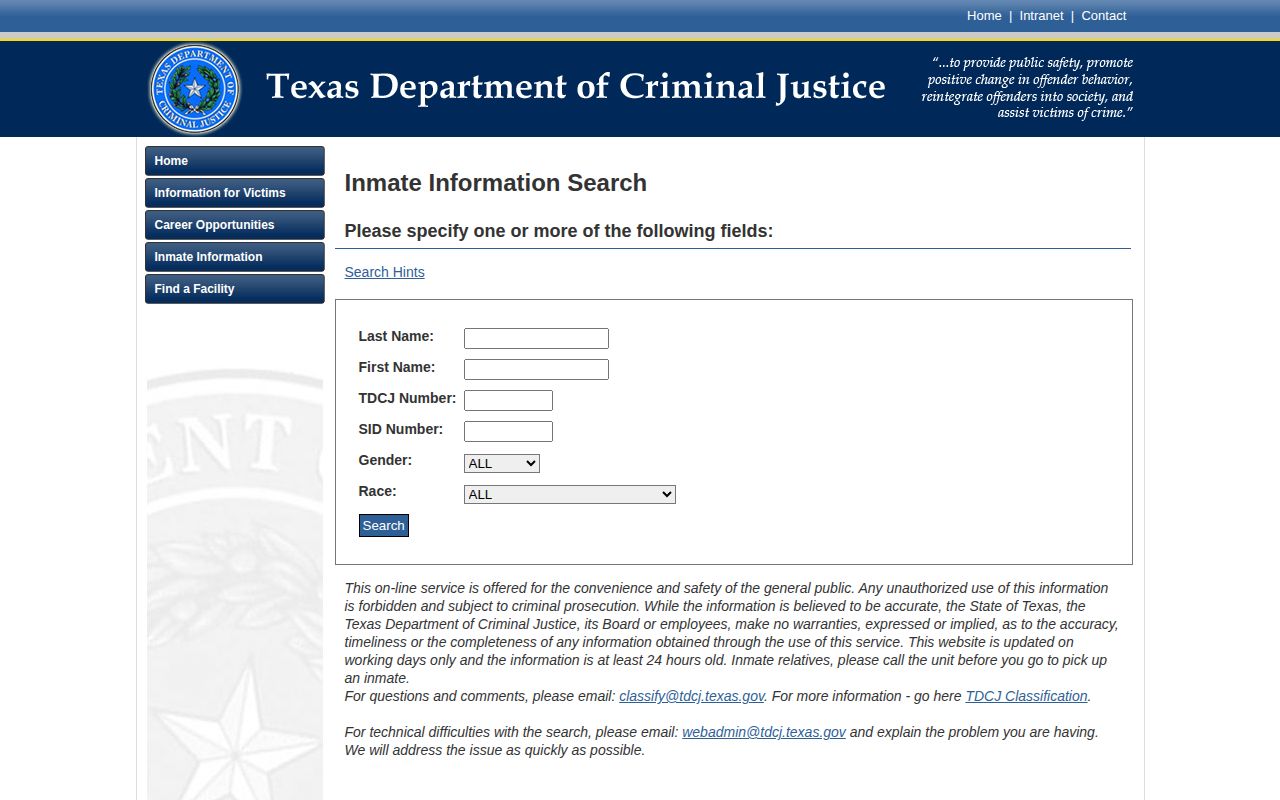
The current-only warning is why Dallas County and TDCJ records must be treated as separate custody segments.
Dallas Release Alerts and Federal Searches
Texas VINE is a status and notification layer for participating reporting agencies. Search the named person, resolve close matches by identifier and agency, and save the agency name with the event. “Out of Custody” means the named agency no longer reports custody. It is not a certified Dallas County release sheet and does not exclude transfer. Dallas County DA Victim Services provides the local VINE referral and statewide hotline.
Federal cases require different sources. The BOP Inmate Locator covers federal prisoners from 1982 forward and may retain a release date with “Released” or “Not in BOP Custody.” BOP warns that another authority may still have the person. USMS has no comparable public person locator, so federal pretrial custody may require the docket and holding facility. ICE ODLS searches current and recently released immigration detainees by A-number and country of birth or by exact identity fields. Each result proves only its agency boundary.
Dallas Supervision After Release
Parole, mandatory supervision, and probation are distinct. Parole is discretionary release from TDCJ imprisonment for the rest of a sentence under supervision. Mandatory supervision follows its own statutory eligibility and review rules. Dallas County probation, also called community supervision, is ordered by a court and administered by Dallas County CSCD rather than the Texas Board of Pardons and Paroles.
Texas has no public retained list of all former parolees. Confirm a parole assignment through TDCJ and the live Region II directory, which lists Dallas I through Dallas V offices, a satellite, and the Dallas I District Reentry Center. Residence alone does not prove the assigned office. For probation, use the signed Dallas judgment and the appropriate CSCD channel. A parole vote before release is not proof of physical departure, and a warrant allegation is not a completed discharge.
Dallas Operational Releases Include Transfers
The January 2026 Dallas jail packet separates time-served processing from transports or releases to the TDCJ Institutional Division, an Intermediate Sanction Facility, a Substance Abuse Felony Punishment Facility, and State Jail. That local vocabulary matters. A row labeled as a release in an operational table may describe movement into another form of confinement.
Never use an aggregate transport category as proof about one person. Connect the Dallas booking to its Sheriff transaction, then verify the receiving authority. TDCJ handles state placements. BOP or USMS handles the federal segment. ICE ODLS and ERO handle immigration custody. Another local jail owns its own later release record. This agency-by-agency method prevents a roster disappearance from becoming an unsupported claim of community release.
Dallas County Release Facility Map
The county map includes active jail towers, historical county buildings, municipal jails, a state prison, a federal prison, and immigration offices or detention. They do not share one release record. Lew Sterrett is the county intake and release node. North, West, and Suzanne Lee Kays are county placement towers. George Allen is depopulated, while the Old Jail and Decker are closed. Municipal facilities must be checked city first. Hutchins uses TDCJ, FCI Seagoville uses BOP, and ICE matters use ODLS.
- Lew Sterrett Intake/Release Center, Dallas County intake and release processing
- North Tower Detention Facility, county maximum-security placement processed through Lew Sterrett
- West Tower Detention Facility, county placement where an internal tower move is not release
- Suzanne Lee Kays Detention Facility, South Tower county placement
- George Allen, Old Jail, and Decker, historical Dallas County record routes
- Dallas, Garland, Grand Prairie, Irving, Mesquite, and Carrollton city jails, each requiring city-first confirmation
- Hutchins Unit, FCI Seagoville, Dallas ICE Field Office, and Prairieland, each using its state or federal system
The Sheriff says the system has four active facilities and more than 7,100 beds, while the same detention-center page individually describes three active placement towers. Preserve that inconsistency. Do not invent a fourth tower. Confirm any later operational change with the Sheriff.